No Flooding
No forcing your dog into full panic.
Instant online access • Start today • 30-day money-back guarantee
The Home Alone Method™
A clear, structured programme built around just 10 minutes of practice a day, helping you identify the real problem, know when your dog is ready to progress, and recover from setbacks without starting over.

You are not dealing with an unusual dog. While leading research found that 8 out of 10 dogs struggle when alone, separation-related distress is a common reality for dogs everywhere.

Secure checkout. Instant digital access.
30-day money-back guarantee · Card & PayPal accepted · SSL encrypted
Built around international veterinary and behaviour guidance.
Full sources included.
THE PROBLEM

It starts before you even touch the door handle. Your keys jingle, and your dog is already pacing.
The second the door closes, it begins. For some dogs, it's barking, not just a few barks, but the kind of howling that carries through walls. For other dogs, there's no sound at all. Just a dog who goes still, and stays that way until you're back.
Either way, you come home to the evidence. Scratched doorframes. A chewed skirting board. Or nothing visibly wrong at all, just a dog who seems more than usually relieved to see you.
You've turned down a dinner invitation because someone has to stay with the dog. You've looked at a weekend away and quietly decided it isn't worth the stress of arranging cover. You've stood at the front door for an extra thirty seconds, keys in hand, working out whether today is a bad day to leave.
You've wondered what the neighbours think, every time you hear the howling start up through the wall as you walk to the car. None of that is because anything is wrong with how much you care. It's because leaving has stopped feeling simple.
WHAT IS ACTUALLY HAPPENING
Your dog reacts to the signals that predict your departure: keys, shoes, a coat or a bag. By the time you reach the door, the panic may already have started, and once it peaks, it stays high for the whole absence.

Illustrative chart for educational purposes. Results vary by dog.
That's why a longer absence does not teach a dog to settle. Rushing home and avoiding departures can keep the cycle going. The method interrupts it gradually, before panic takes over.
THE COST OF WAITING
It rarely stays where it is. Ten minutes of barking can become the whole time you’re gone. A scratched doorframe can become a repair bill you did not expect. The neighbour who used to wave can start avoiding eye contact. You’re still trying to manage a problem without the right guidance.
WHY IT HAS NOT WORKED
None of these fix the root cause. Some of them actually make it worse.
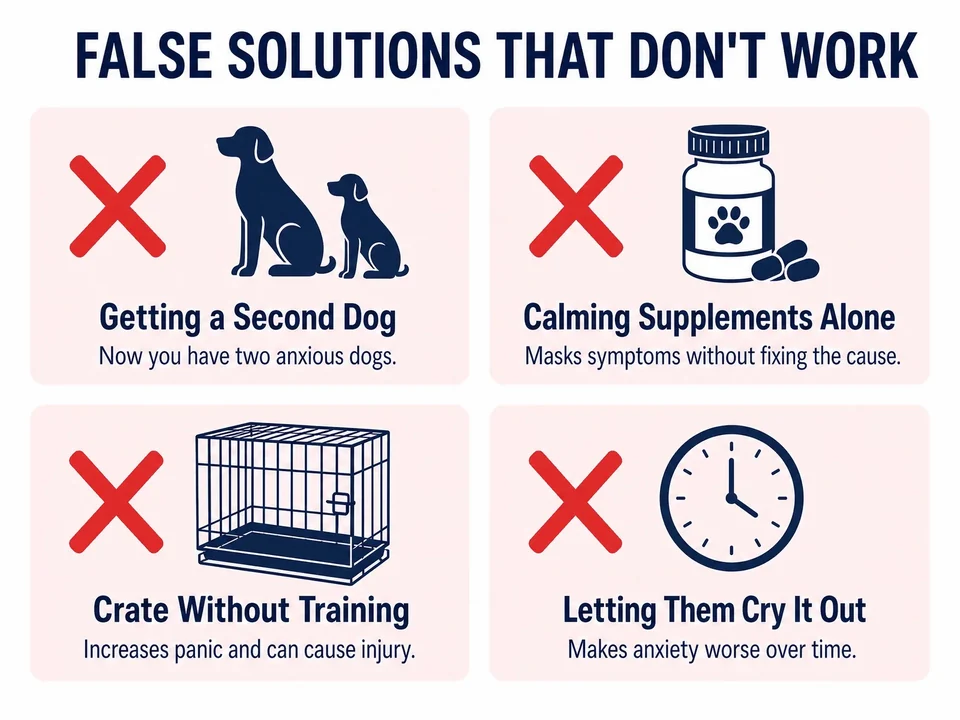
This programme is not based on opinion. It follows systematic desensitisation, the approach with the strongest support in the veterinary behaviour literature for separation-related problems.
That means:
No forcing your dog into full panic.
The programme never uses punishment.
No leaving your dog to panic alone.
Progress at your dog’s own pace.
The RSPCA is explicit that leaving a dog to cry it out is harmful. This programme never asks you to do that. Every claim is sourced, with guidance drawn from the ASPCA, the RSPCA, the American Veterinary Society of Animal Behavior and peer-reviewed veterinary research.
A self-guided programme, not a substitute for individual veterinary or behavioural advice. If your dog shows aggression or needs support beyond a self-guided programme, please consult a vet or qualified behaviourist.
A Personal Note
My name is Sheila, and my interest in separation anxiety began with my father's Rhodesian Ridgeback, Candy. My father lived by himself, and Candy would show signs of anxiety whenever he went out, which meant he couldn't comfortably leave her for very long. Seeing how much that restricted his life stayed with me and eventually led me to build a clear, structured path that other owners could follow.

THE OUTCOME

Imagine walking to the door and your dog barely lifts their head. Being able to go out without that dread in your stomach. Coming home to a relaxed dog, not a mess to clean up. Having more freedom to make plans without your dog's anxiety controlling every decision.
That is the goal. Not overnight, and not on a fixed timetable, but gradually, at your dog's pace.
SUITABILITY
This is for you if:
This is not for you if:
WHAT IS INCLUDED
The Home Alone Method™ is one complete digital playbook hosted on Notion, built around the Duration Ladder with the guidance and contingency tools you need for real-world training.
Built around just 10 minutes of daily practice.
Access it on your phone, tablet or computer through a secure link, with no app, account or clunky PDF to manage.
It answers the three questions where most owners get stuck: Where do I start with my dog? When should I progress? And what do I do when real life interrupts training?
A structured, phase-by-phase progression that builds calm alone time from seconds to hours, at your dog’s pace.
The exact low-drama way to leave and return, so your exits stop feeling like a big event to your dog.
Breaks the link between keys, shoes and coat and panic, so departure cues stop triggering a reaction before you even leave. Only some dogs need this one.
Most methods tell you to progress at your dog’s pace without telling you how to know what that pace is. This is a simple, objective check that answers it.
A clear response for bad days, so one setback does not make you abandon the training.
What to do when you must be out longer than your dog is ready for, so one unavoidable absence does not undo your work.
ALSO INCLUDED
Helpful extras that make the method easier to follow. Not more things to learn, just support.
Five well-intentioned habits, like comforting your dog before leaving or sneaking out, that can make separation anxiety worse, and what to do instead.
A varied rotation of long-lasting chews, frozen food toys, puzzle feeders and scatter games, with practical safety guidance.
THE METHOD
The heart of the programme is the Duration Ladder: six phases that gradually build your dog's calm alone time, at their own pace. No flooding, no forcing.
Build calm at the front door
Build calm through brief out-of-sight moments
Build from 1–5 minutes alone
Work gradually towards 30 calm minutes
Extend into real-world absences
Build towards
2–4 hours alone
Phase 6 builds towards 2–4 calm hours alone, the maximum recommended by leading welfare organisations such as the RSPCA for a dog's mental and physical well-being.
If you need to be away for longer, the programme explains how to manage this responsibly, without expecting your dog to remain alone for an entire working day.
You establish which problem you are solving. About five minutes.
If your dog reacts to your departure cues, you pick up your keys and put them back down again. If they do not, you skip that stage entirely and start at the door.
Around 10 minutes of active training, split across two short sessions.
The first thing most owners notice is not a longer absence but a change in the run-up: your dog lifting their head instead of leaping up, or following you to the door without starting to pant. Those small shifts usually come before the clock moves, and they are the genuine early sign this is working.
THE COMPARISON
In a survey of over 1,000 pet owners, those dealing with separation anxiety reported spending an average of
$330 a year
on it: supplements, daycare, replaced door frames, cancelled plans. Most of that money manages the symptoms rather than resolving the cause.
Professional separation anxiety programmes run from hundreds into thousands, and one-to-one trainers typically charge $80 to $200 a session.
The Home Alone Method gives you a complete, structured desensitisation system: from the earliest departure triggers to gradually building calmer, more confident alone time. All for $47. Less than a single session with a trainer. Less than one chewed-up pair of shoes.
“I priced this at $47 because every dog owner deserves the complete solution, not just those who can afford expensive professional programmes. That is the whole reason it exists at this price.” - Sheila, Founder, The Home Alone Method™
Upon completing your purchase, you will receive immediate access to The Home Alone Method™ online programme, so you can begin your first exercise today.
Your purchase is protected by a 30-Day Money-Back Guarantee. If you find that the method isn't the right fit for your situation, simply email support@thehomealonemethod.com within 30 days of purchase and I will issue a full refund of your $47 purchase price.
Every dog will progress at their own pace. The aim is steady, gradual progress as you work through the method consistently, without rushing your dog or forcing them beyond what they can comfortably handle.
Secure checkout. Instant digital access.
QUESTIONS
Every dog progresses at a different pace. This issue does not resolve in days. The first change most owners notice is a calmer reaction to departure cues like picking up keys or putting on shoes. Building the confidence to stay home alone for hours takes longer. The program is built to measure your actual stage rather than force you against a strict timetable.
Yes. The exercises begin with very short separations and progress according to your individual dog's responses.
Puppies: The focus is on teaching them that short periods alone are safe. Young puppies have different developmental and toileting needs, so long-duration stages are not intended for them.
Rescues & Seniors: They can work through the method at their own pace. Some may need more time in the early phases depending on their history.
Free advice gives you random pieces with no structure. This program gives you a complete, step-by-step system with daily exercises, clear progression criteria, and emergency protocols.
Most exercises take 10 minutes or less, and many take under five minutes. The programme is built around short, deliberate practice rather than hour-long drills, so it can fit around a normal working day. Consistency matters more than doing long sessions occasionally.
This is exactly what the program was built for. The Confidence Checkpoint gives you an objective test to see if your dog is truly ready to progress. The Setback Recovery System tells you exactly how to handle bad days so you do not lose your progress.
The method starts at the front door. We build calm there before ever introducing out-of-sight moments. Severe cases will simply need more time in the early phases. Some dogs may also benefit from support from a vet alongside this training.
The program uses the exact same desensitisation principles used by professional behaviorists. The only difference is that you are following a structured, self-guided system rather than paying hundreds of dollars for a private coach.
If your dog panics, the current step is too difficult or you moved forward too fast. The program includes a Setback Recovery System and troubleshooting guides to help you adjust your pace.
Give your dog the structure they need to finally feel safe alone.
A complete, structured separation anxiety system, including the readiness test, the setback plan and the real-life contingency that most programmes leave out. $47, in your hands, starting today.
YES, I'M READY - $47Secure checkout. Instant access.